


.png)

How Technology Is Making Protesters Easier to Track

Updated: Aug 4
What the CJP protests reveal about digital surveillance and the future of dissent
A TECHNICAL HUMAN-RIGHTS ANALYSIS
At a protest, you expect to be seen. That is partly the point. You stand in a public place, hold a placard, chant a slogan and make a political demand visible.
But being seen is not the same as being identified by a machine.
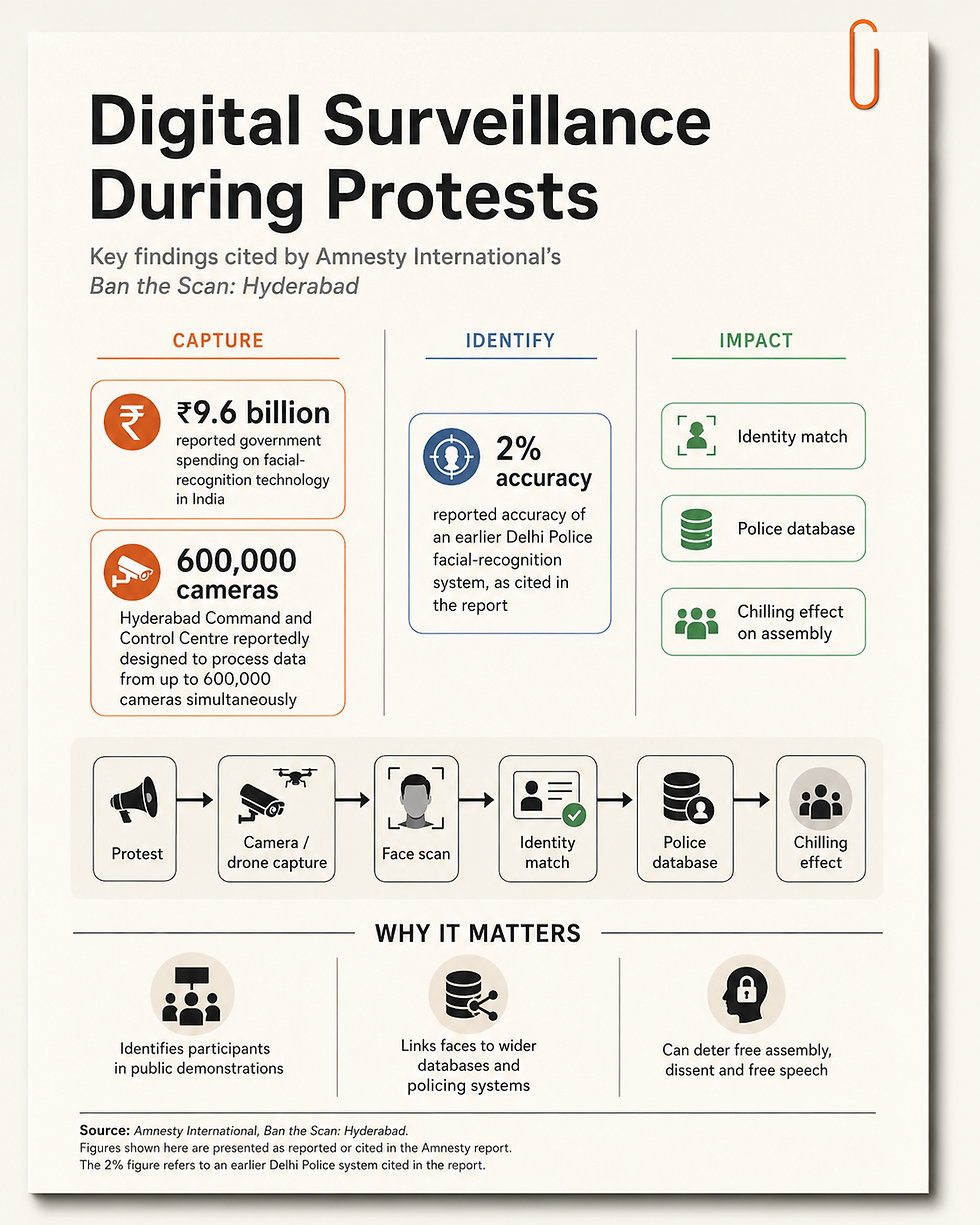
That distinction has moved from theory to the streets of Delhi. During the Cockroach Janta Party (CJP) protest at Jantar Mantar over repeated examination paper leaks, The Indian Express and the Internet Freedom Foundation (IFF) reported two Delhi Police surveillance vehicles at the site. Inside a vehicle called Ikshana, live CCTV feeds were reportedly processed through facial-recognition software, with faces boxed for comparison against a police database. IFF also pointed to earlier police disclosures stating that there was no specific rule governing facial recognition, no privacy impact assessment, and no clear retention framework.
The CJP protest matters beyond the controversy that produced it. It offers a glimpse of a larger transformation in the relationship between protester and State. A demonstration is no longer only a physical gathering. It can also become a data-generating event.
A camera can capture your face. Your phone can reveal that a device associated with you was nearby. Social-media activity can show who you communicate with. AI systems can connect these fragments.
The question is no longer simply: "Was I photographed?" It is: "What can now be inferred about me because I was there?"
THE DISTINCTION - BEING SEEN IS NOT THE SAME AS BEING IDENTIFIED BY A MACHINE. |
THE CROWD USED TO PROVIDE A KIND OF PRIVACY
For most of modern history, protests contained a practical protection: scale. A police officer could look at a crowd of ten thousand people, but could not instantly name everyone in it. A photograph might preserve your face, but did not automatically connect it to a database.
Digital systems remove those natural limits.
The UN High Commissioner for Human Rights has described facial recognition as a "paradigm shift" for assemblies. The technology can convert a face in a photograph or video into a mathematical template and compare it with templates in a database. When this happens on a live feed, identification can occur while a person is moving through the protest site.
Once a face is linked to an identity, observation becomes attribution. A person is no longer merely part of a crowd; the State may know exactly who attended. Privacy International argues that indiscriminate protest surveillance can force people to choose between protecting their anonymity and exercising their right to protest.3
That is a serious democratic trade-off, not simply a question of cameras in public.
CAMERA | FACE | TEMPLATE | DATABASE | POSSIBLE IDENTITY |
ACCURACY IS NOT THE WHOLE QUESTION
Debate around facial recognition often focuses on mistakes. False matches can cause innocent people to be questioned or treated as suspects, and uneven performance across demographic groups creates additional risks.
But imagine a facial-recognition system that is perfect: it identifies every peaceful protester correctly. That does not solve the civil-liberties problem. It sharpens it. Perfect accuracy could eliminate practical anonymity and create a reliable record of who attended an anti-government march, a labour rally, a religious demonstration or a gathering supporting an unpopular political view.
International human-rights law does not ask only whether a surveillance tool works. It asks whether the interference has a clear legal basis, pursues a legitimate objective, is necessary and is proportionate. The UN's 2020 report on technology and peaceful assemblies says authorities should generally refrain from recording participants, with exceptions tied to concrete indications of serious criminal conduct. Privacy International similarly argues that biometric technologies should not be used to identify people merely because they are peacefully protesting.
So the real question is not: "Can the algorithm recognise this person?"
It is: "Why does the State need to recognise this person at all?"
THE ACCURACY FALLACY - THE REAL QUESTION IS NOT WHETHER THE ALGORITHM CAN RECOGNISE YOU. IT IS WHY THE STATE NEEDS TO RECOGNISE YOU AT ALL. |
YOUR PHONE IS ALSO PART OF THE PROTEST SITE
The face is only one source of data. A smartphone continuously interacts with communications infrastructure. An IMSI catcher, or cell-site simulator, mimics aspects of a legitimate mobile tower and can be used to identify or locate nearby devices. The unsettling feature is the direction of the search. A conventional investigation begins with a person and seeks information connected to that person. Location-based surveillance can reverse the logic: start with a protest site, collect device information there, and then work towards the people behind it.
PERSON > SUSPICION > INVESTIGATION can become LOCATION > DEVICES > PEOPLE.
Presence at a peaceful political gathering is not evidence of criminal conduct. There is no public evidence that IMSI catchers were used against the CJP protesters. The point is not to speculate, but to understand the environment in which modern demonstrations operate. Privacy International catalogues CCTV, drones, social-media intelligence, biometric recognition, phone extraction, hacking and malware as tools that can operate before, during and after protests.
THE SURVEILLANCE "ECOSYSTEM"
The UN Special Rapporteur's 2026 report offers perhaps the best term for what is happening: a surveillance ecosystem. Facial recognition, spyware, city camera networks and online monitoring may look separate, but modern systems are increasingly interoperable. Biometric identification can be applied to video, linked with social-media intelligence or administrative records, and processed using AI. The shift is from collecting a piece of evidence to building a pattern.
Who repeatedly attends demonstrations? Who travels with whom? Which accounts interact? Who appears to organise others?
This is where surveillance becomes more consequential than ordinary CCTV. It can map not only individuals, but relationships.
And protest is, by definition, relational. It is the act of people coming together around a common objective. A surveillance architecture capable of reconstructing those connections reaches into the structure of collective political action itself.
THE BIG IDEA - PROTEST SURVEILLANCE IS NO LONGER ONE CAMERA. IT IS AN ECOSYSTEM. |
THE MOST POWERFUL SURVEILLANCE MAY BE THE SURVEILLANCE YOU ONLY SUSPECT
A surveillance system does not need to arrest everybody to alter behaviour.
At Jantar Mantar, IFF reported that students were covering their faces and that some feared being placed in police databases or having images reach their parents or educational institutions. Whatever ultimately emerges from litigation and official disclosures, that reaction captures the "chilling effect" with unusual clarity. The 2026 UN Special Rapporteur's report describes people changing who they speak to, reducing public visibility, softening advocacy and withdrawing from assemblies because surveillance may expose colleagues and family members too. Uncertainty can make this form of power stronger. If you do not know what is recorded, where it is stored, how long it is kept, who can access it or what future algorithm may analyse it, the rational response is often to assume the broadest possibility.
Surveillance then migrates from the camera into the mind.
"Maybe they are watching" can influence behaviour almost as effectively as "they are watching."
PUBLIC DOES NOT MEAN PRIVACY-FREE
The easiest defence of protest surveillance is also the most intuitive: a protest is public, so what privacy can a protester expect?
Human-rights law rejects that simple equation. The UN Human Rights Committee has recognised that the fact that an assembly occurs in public does not eliminate participants' privacy interests, including against technologies capable of identifying individuals in a crowd.
The difference becomes obvious when we separate visibility from processing. A stranger seeing you at Jantar Mantar is not the same as a State system converting your face into biometric data, checking databases, retaining the result and potentially linking it with other information.
The difference is scale, computing power, institutional authority and memory.
POLICE DO NOT HAVE TO BE BLIND
None of this means that police should be technologically blind at demonstrations.
States have legitimate duties to protect participants and investigate serious offences. International human-rights law does not prohibit targeted investigation. It demands a distinction between investigating wrongdoing and treating an entire assembly as an investigative dataset.
A practical framework follows: clear legal basis, concrete justification for intrusive identification, strict retention limits, independent oversight, and meaningful routes to challenge unlawful surveillance. Peaceful participation should not itself create a biometric record.
Technology should follow suspicion, rather than manufacture it from mere presence.
THE FREEDOM TO LEAVE THE CROWD
The CJP protests may ultimately be remembered as a political story about examinations, accountability and youth anger. But the surveillance controversy around Jantar Mantar presents a second story, one likely to outlast this movement. Democracy has always depended on citizens being able to appear together in public and challenge power. For centuries, the crowd itself provided a modest layer of protection: you could be visible as part of a political collective without automatically becoming a permanently identifiable data point.
That protection is eroding.
And this is why the most frightening facial-recognition system may not be the one that gets your identity wrong. It may be the one that gets it right every single time.
A democratic society must therefore decide what it wants technology to remember.
The freedom to protest cannot mean only the freedom to enter a crowd.
In the age of digital surveillance, it must also include the freedom to leave it without the crowd following you home.
THE DEMOCRATIC TEST - THE FREEDOM TO PROTEST MUST INCLUDE THE FREEDOM TO LEAVE THE CROWD WITHOUT THE CROWD FOLLOWING YOU HOME. |
JURISPRUDENCE ANALYSIS
Read together, Justice K.S. Puttaswamy v. Union of India, R (Bridges) v. Chief Constable of South Wales Police, Leaders of a Beautiful Struggle v. Baltimore Police Department and Glukhin v. Russia mark a decisive shift in privacy jurisprudence: from protecting individuals against physical intrusion into private spaces to protecting them against digital identification, aggregation and inference in public life. The central proposition emerging from these decisions is that public visibility is not equivalent to consent to State identification. A protester may choose to make a political demand visible without agreeing that her face, movements, associations and ideological commitments may be converted into a permanent, searchable record.
The constitutional foundation for this principle lies in Puttaswamy, where the Supreme Court of India held that privacy “is not lost or surrendered merely because the individual is in a public place.” Privacy, therefore, attaches to the person rather than merely to a location. This distinction is crucial in the context of protests. The relevant interference is not that a police officer or passer-by can see a participant; it is that technology can transform momentary visibility into lasting attribution. A face can be converted into biometric data, compared against a database, connected with other records and retained for future use. Puttaswamy consequently requires restraints upon privacy to satisfy legality, a legitimate State aim and proportionality. General policing powers cannot, without more, justify an architecture capable of cataloguing peaceful political participation.
Bridges gives operational meaning to that requirement of legality. The Court of Appeal recognised that facial recognition processes the biometric data of large numbers of people, “the vast majority” of whom are of “no interest whatsoever to the police.” The defect was not simply that the technology was intrusive, but that the governing framework failed to impose adequate limits on who could be placed on a watchlist and where the system could be deployed. The Court identified “fundamental deficiencies” in the legal framework and held that the deployment was not “in accordance with the law.” Legality, on this reasoning, means more than the existence of a broad statutory power. The law must constrain official discretion before surveillance begins. A regime that permits the police to decide for themselves where facial recognition will operate and whose faces will be searched risks converting proportionality into an after-the-fact justification for an initially standardless power.
Leaders of a Beautiful Struggle carries the analysis from identification to aggregation. The Fourth Circuit rejected the idea that constitutional scrutiny should focus only on what each individual aerial image revealed. The surveillance programme created a “detailed, encyclopedic” record of public movements and allowed the police to “travel back in time” to reconstruct a person’s whereabouts. Its effect was compared to attaching an “ankle monitor” to every person in the city. The jurisprudential insight is that the whole can be far more intrusive than its individual parts. A CCTV image, telephone-location signal or social-media connection may appear limited when examined separately. Combined over time, however, they can reveal who repeatedly attends demonstrations, who travels with whom, who organises others and which political causes a person supports. The proper constitutional unit of analysis is therefore not the isolated camera or database, but the surveillance ecosystem created by their interoperability.
Glukhin completes the argument by connecting privacy directly with democratic expression. Russian authorities used facial-recognition technology to identify and later locate a man who had conducted a peaceful solo demonstration. The European Court of Human Rights found the processing of his biometric data “particularly intrusive”, observing that the protest had posed no danger to public order or safety. Its use did not correspond to “a pressing social need” and was not “necessary in a democratic society.” The interference was therefore not merely informational. Surveillance became a means through which peaceful expression produced identification, prosecution and arrest. Once that possibility becomes known, its effects extend beyond the person identified: every future participant must decide whether speaking publicly is worth becoming permanently traceable.
Together, these judgments dismantle the assumption that accuracy is the decisive legal question. An inaccurate system risks false accusation, but a perfectly accurate one may eliminate practical anonymity altogether. The emerging principle is that surveillance must follow individualised justification rather than manufacture suspicion from collective presence. A lawful investigation ordinarily moves from suspected wrongdoing, to an identified target, and then to a proportionate investigative tool. Indiscriminate protest surveillance reverses that sequence: it begins with a location, captures everyone present and searches retrospectively for individuals of interest. That reversal transforms an assembly into an investigative dataset and every participant into a provisional suspect. A democratic society need not require the police to be technologically blind, but it must prevent technology from making peaceful dissent permanently identifiable, searchable and reconstructable. The freedom to protest must therefore protect not only the right to enter a crowd, but also the right to leave it without the State carrying a digital record of the crowd home.

Comments